Tuesday, 11 June 2013

(P.S. Pompeii and Sorrento)

There is an old train system called the Circumvesuviana which departs from Naples's Central Station. I would guess these trains have been "around the block" a few times as they wear decorative layers of graffiti on most cars, but regardless of age the reliable service transports millions of visitors to some of the most popular tourist attractions in Southern Italy every year. This would include my sister and I on our way to small coastal town of Sorrento.

 
After the bustling streets of Rome, I found the Mediterranean feel of Sorrento very beautiful and relaxing. The town is well-presented with maintained flower beds and attractive ceramic signs like the one above. The entire industry is geared towards meeting the needs of tourists, especially retirees and young families. Laura found it a bit too touristy for her liking, but despite this we had an enjoyable time exploring its streets and shops. Here we took our first of MANY coastal pictures.


Sorrento acts as a central hub to a lot of surrounding attractions which can be easily visited on day trips, such as the ruins of Pompeii, Island of Capri and the Amalfi Coast. Sorrento is also well-known for its prosperous lemon orchards and its resulting invention of the Italian liqueur limoncello. This lemon-flavoured spirit packs a powerful punch of sour and sweet and can be found in souvenir shops across Italy. Most of the information I had read about Sorrento chastised its lack of substantial beach, but this proved no problem for us as we found it too chilly to swim or sun-bathe. Besides if the mood had struck us we could have used the lovely pool at the Hotel Florida where we were staying.

Walking through a downtown lemon orchard.
 Bottles of limoncello in every shape and size.
 Life is tough at Hotel Florida.
 
Pompeii is yet another of those places I have heard about my entire life. It is an ancient Roman city that was covered by 4 to 6 metres (13 to 20 ft.) of volcanic ash and pumice stone when nearby Mount Vesuvius erupted in 79 AD. These light substances meant that the city was well-preserved and easy to excavate when formal archaeological works began at the end of the 19th century. Interestingly, there is evidence that Pompeii had still been recovering from a severe earthquake it suffered 18 years before the eruption. The population of the city at the time of its demise is estimated anywhere from 20,000 to 35,000 people. It was not a small city and nowadays is a surprising challenge to walk around. Our visit lasted five hours and I was exceedingly glad we were not suffering from the dead heat of summer.
 
 Looking towards the ruins of Pompeii from the main entrance.
A view of Mount Vesuvius. Note the crater top.
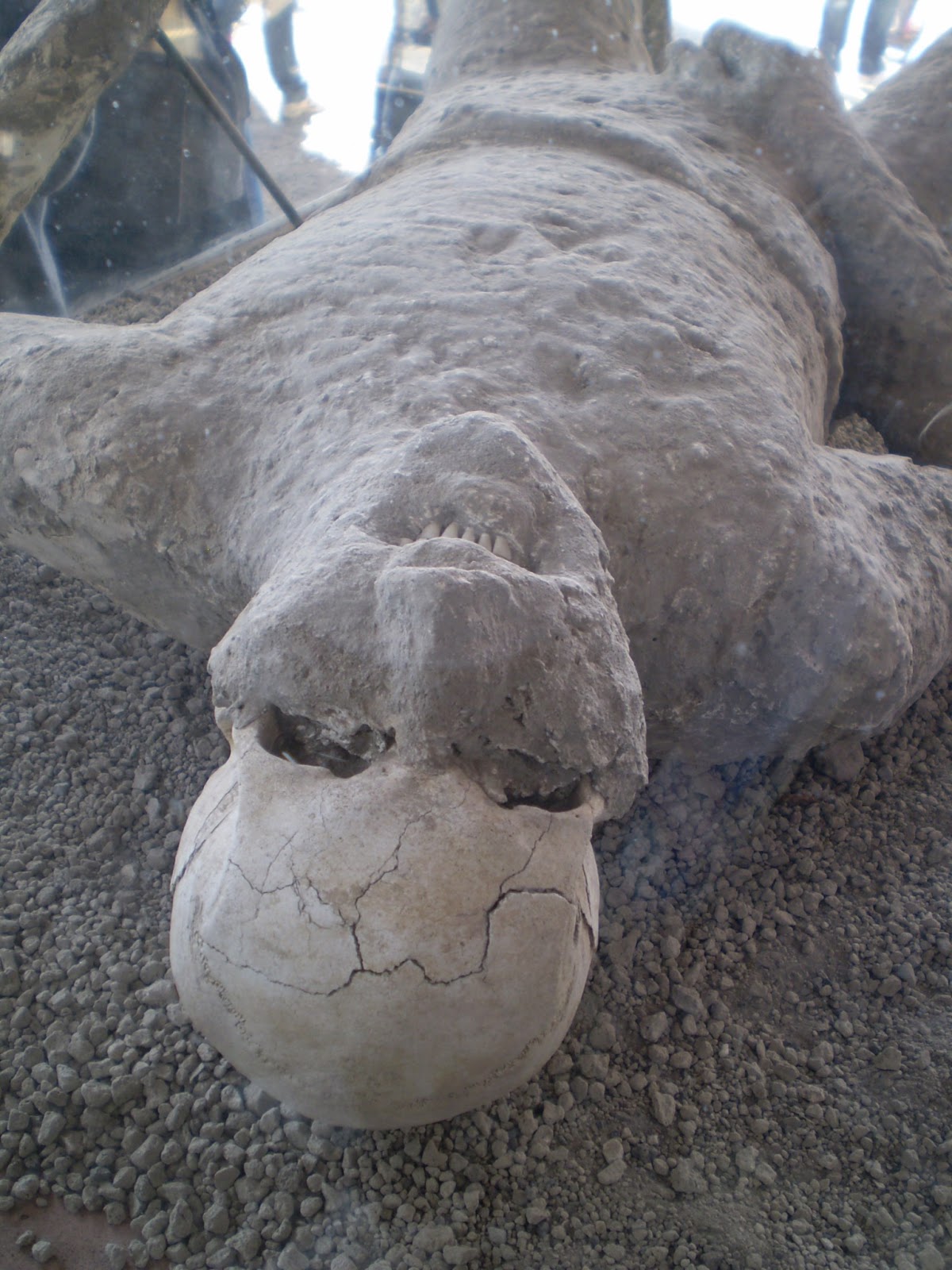
 Perhaps the most famous parts of Pompeii are its preserved objects and the plaster molds made from the imprints of bodies. Many have been removed to museums, but there are still some onsite. I was really amazed to see how short the people were; they could not have been any taller than me.

Some of the more impressive structures were the Amphitheatre (above) where gladiators fought and the Grand Theatre (below) used for other performances. 

Hygiene appears to have been very important to the ancient Romans as there were four public baths in the city. They were often ornately decorated like the one above. The biggest even included a gymnasium and swimming pool.
 Pompeii showcases a variety of art, including graffiti artfully written along some streets, but the best-preserved examples are located in the Villa dei Misteri (Villa of Mysteries) outside one of the city's gates. The above picture is of the Villa's most decorated room. Completely fabulous.


Laura's favourite part of Pompeii?? The Poppies. Well not really, but she did greatly admire them and why not? They really added a brilliant splash of colour to the ruins.
 
I took many, many pictures of Pompeii... too many to all share here. There are plenty of temples, administrative buildings, homes, even a Laundromat and "fast-food" joint. It is well worth the visit and very memorable. However learn from my mistake and remember to pack the sunscreen!
 
Ciao!
Shannon

Sunday, 9 June 2013

More from Rome

I find it slightly amusing that we saved the biggest Roman attraction till our third day. How could I patiently attend to all those other sights when I knew the Colosseum was waiting? In reality I had not planned my sight-seeing in this backward manner, but it worked out in the end as we were able to devote our entire third day to exploring the ancient amphitheatre and the surrounding Roman Forum.

I suppose to be completely accurate, we first saw the Colosseum on our second evening when we chose to walk by it at night to snap pictures of it lit up. There is a certain bubbling excitement that comes with knowing you are approaching one of the most famous structures in the world. I cannot remember the first time I heard of the Colosseum; it is a monument you know of all your life. Seeing it in person is a major tick off my “bucket list.”


The next morning we arrived once again and our daytime views gave light to some of the architectural details we did not notice the night before. In some respects, the structure looks extremely fragile and you begin to wonder how the Colosseum still remains standing. We would learn later in our tour that the building was built largely out of a stone called travertine, held together with metal clamps and overlaid with marble. However once the Colosseum had passed its prime it was used as a quarry and stripped of its marble and metal. Now as you look around the structure there are holes in its façade where the metal clamps were removed. Yet still it stands.


We had to wait in line for an hour to get our tickets, and although being sunny outdoors it was a bit chilly standing under the arcades (exterior arches). The inside of the Colosseum was worth the wait as it was completely fascinating. It once could seat 70,000 people and had an enormous awning, opened by sailors from Naples, to shade spectators. The central belly of the amphitheatre is of course now exposed to the elements, but was once covered by a stage floor of wood and sand. There were a series of pens and elevators underneath which would lift animals and gladiators up into the ring.


Events at the Colosseum were not a frequent as you may think (a single gladiator may only compete two or three times a year), but when they did take place they could go on for several days. The opening ceremony of the amphitheatre in 80 AD lasted 100 days. During these celebrations, three types of battle would regularly occur: gladiators vs. wild animals, public executions by animal or gladiator, and fights between gladiators. The animals included elephants, tigers, bears, lions, hippopotamus, ostriches, etc.  If I gladiator survived his service for five years he was granted freedom (not that all gladiators were slaves). The massive amphitheatre was truly a symbol of Rome’s wealth, power and dominance.

It is easy to fill a day with all of the ruins in the area near the Colosseum, and it was convenient that the ticket we patiently waited for covered these as well. This area, known comprehensively as the Imperial Rome, used to be the central power of Ancient Rome. The ruins that are left today are the remnants of its prosperity 2000 years ago. As much of it was built on lower land, flooding from the River Tiber covered it in silt, and it was not greatly uncovered again until the 1930s. More recently there was a thorough excavation done from 1998-2008, and we even saw some smaller projects underway while we walked around.
Sharing the piazza with the Colosseum is the Constantine Arch, constructed at a somewhat later date (312 AD) in honour of Emperor Constantine’s battle victories. 
 
 Just down the street you can enter the extensive Roman Forum; an attraction you can spend half a day wandering around. An audioguide, or descriptive map is helpful for navigation as the signage is poor in the Forum. When we went all the audioguides were sold out, but luckily Laura had convinced me to buy a small tour book while in the Colosseum. What convenient foresight!
Perhaps the best way to explain the forum is through pictures. Enjoy!
 
 Looking towards "Capital Hill" from the entrance.
Looking towards Palantine Hill.
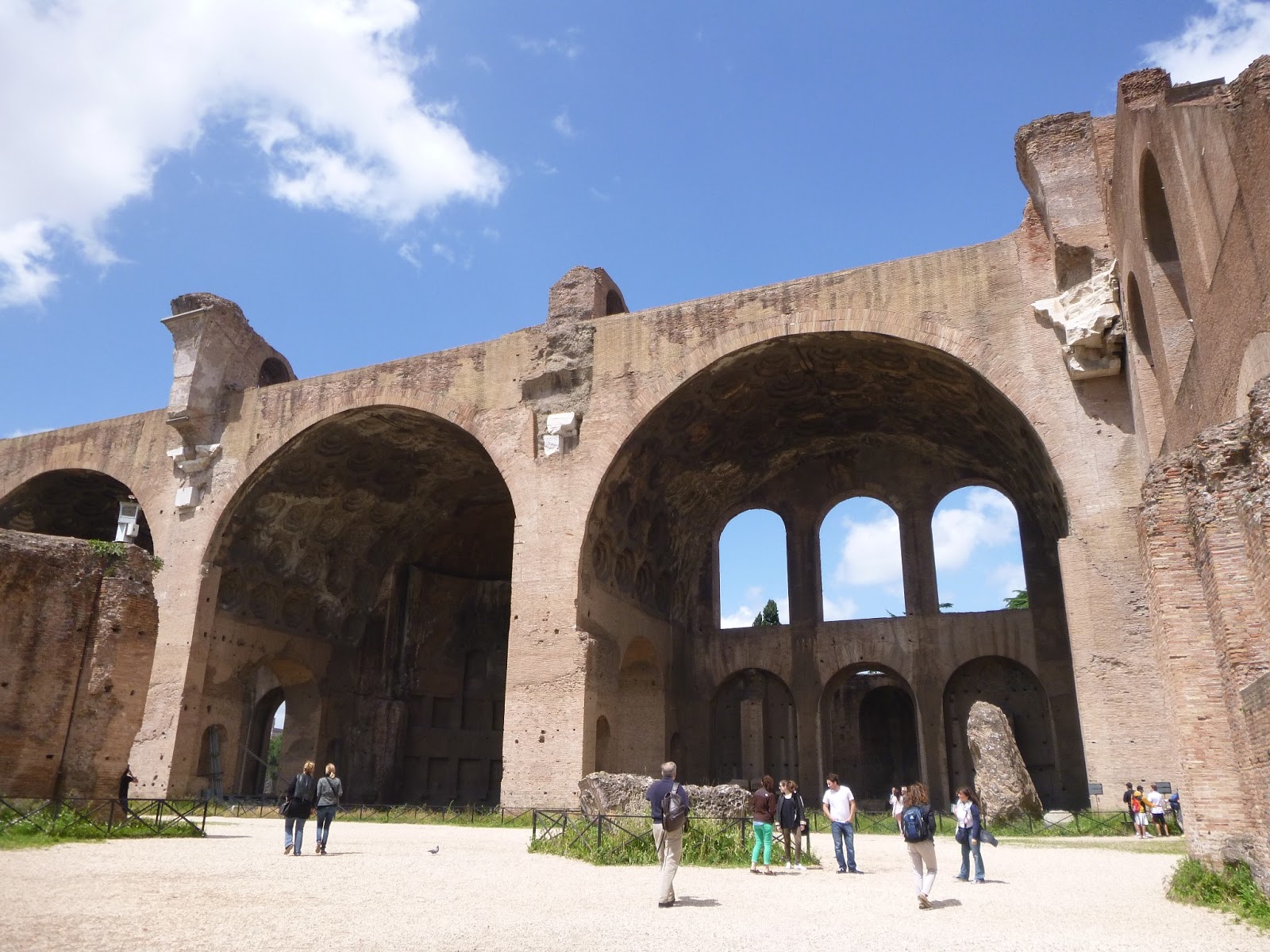
Basilica of Maxentius (or Constantine) which served administrative purposes for the city. The Emperor would make his decisions seated on the chair visible below.  
 
 
 The top of Palantine Hill offered impressive views of our surroundings.


As we descended Palantine Hill we looked down on the Temple of Vesta boasting a pool wreathed by flowers and the remains of columns. This temple once housed the Vestal Virigins who were charged with guarding the ever-burning torch of Rome. In the upper left quadrant of the picture, you can see the Arch of Septimus Severus marking one ancient entrance to the city, as well as the white marble Vittorio Emmanuelle Monument rising behind.
The remaining front of the Temple of Saturn.

We left the Roman Forum on the opposite end of the Colosseum, which took us up a set of steps to the Piazza del Campidoglio on Capital Hill. This square is a very important one for the city as it has housed the highest political offices since the 1100s.The façade of the Piazza was redesigned in 1538 when the bronze Equestrian statue of Marcus Aurelius was added and Michelangelo designed an impressive set of steps leading up to the Piazza. The square is share by two very important museums housing artifacts from Rome’s history, but we sacrificed a visit to spare our sore feet.
The statue of Marcus Aurelius and the Palazzo Senatorio or mayoral office of Rome.
 
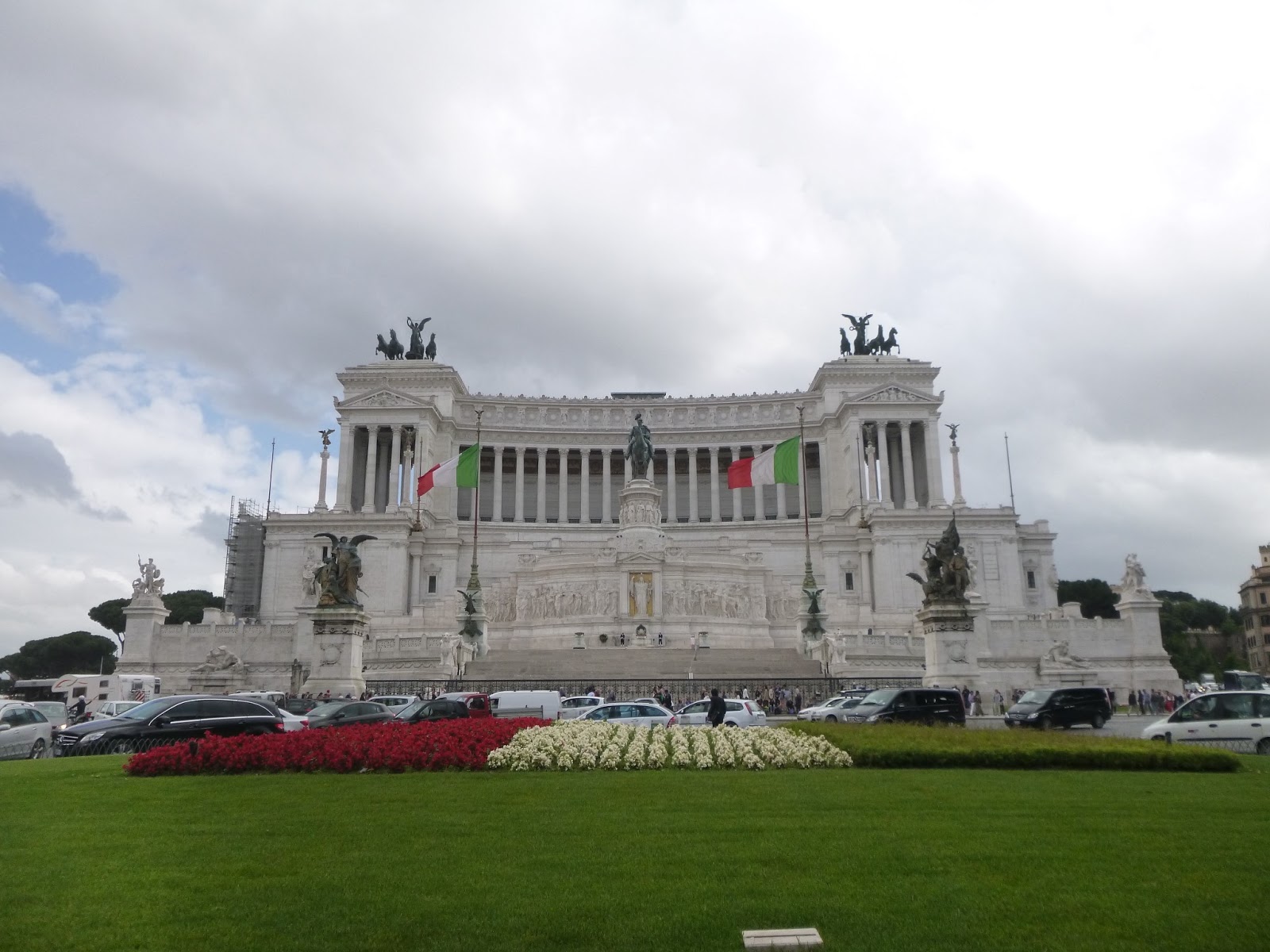
Instead of touring museums, we ascended to the height of the Vittorio Emmanuelle II Monument to gain amazing panoramic views of the city. With the sun shining down I could have happily spent the rest of the day up there. It is hard to tell if the view from the monument is more impressive than the building itself. Built in the early 1900s as a museum, the structure is an impressive mass of marble steps and columns, and is framed by two massive copper statues of winged chariots. I’ll let you decide for yourself by looking at the pictures.


That evening we headed out on the town with three boys from Mississippi who were sharing our hostel room. Humorously enough, we went out to an Irish Pub and I wove them a tale of the wonders of Guinness. Then we went back to the Campo de Fiori for a more authentic Italian experience, as it had turned from bustling market square to thriving nightlife.
Although we could have filled our entire week with Rome alone, both Laura and I wished to see more of Italy. On the Saturday we hopped on a train and headed south to see Pompeii, Sorrento and Capri. More on that next blog!
Ciao!
Shannon


Tuesday, 4 June 2013

Date with the Vatican

A couple of months ago I remember being sucked into the hype surrounding the inauguration of the newest Catholic Pope, Francis I. Personally, I have no strong connection to the Church so at the time it was a bit humorous for me to sit down in front of the TV and await the live-feed of the Pope's first appearance on the balcony of St Peter's Basilica. Little did I know at that time, by the end of May I myself would be standing in St Peter's Square looking up at that same balcony. Perhaps some things do not happen as coincidence because I even had the opportunity to see the Pope in person.

Accessing the Vatican during high tourist season is a nightmare. To enter the popular Vatican Museums and the Sistine Chapel you can face an average wait of three hours in a queue. I HIGHLY recommend buying tickets online first so that you can skip this hassle. Laura and I had the foresight to do just this, so our "date with the Vatican" was on May 23rd at 2pm. To ensure that our morning was productive, we walked across the city towards the Vatican and hit up a few highlights on the way.

Not a far distance from the main street Via Corso sits the ancient Roman temple, the Pantheon. This structure is the best preserved example of ancient Roman architecture, dating back to 118-125AD. The temple was built by Emperor Hadrian, but the still-visible inscription on the front is dedicated to his friend Marcus Agrippa. The massive entrance pillars guard great bronze doors which open on to an arched interior dome and central open skylight. If it rains the water runs into drains in the floor. The simple pattern of the dome makes a breathtaking and memorable impression. Until the 20th century is was the largest concrete dome in the world.


Of course, the Pantheon is yet another popular tourist spot in Rome. On my visit, the one thing I could think about was how amazing it would be to return to the Pantheon after hours, sit alone in the middle of the floor and look up at the sky through the oculus. Needless to say I did not get to do this; I did not make the right Italian friends.

Another street over from the Pantheon is the Piazza Navona which is a great place to go in search of street merchants selling art. I'm surprised I could drag Laura away. In the center of the Piazza is Bernini's Fountain of Four Rivers (with yet another obelisk), and the baroque masterpiece Sant' Agnese of Agone Church, which was as beautiful on the inside as outside.


If you know me well enough, you know that Farmers' Markets are my "thing." They are also my sister's "thing." In fact, it is hard to be a member of my family without developing a strong attachment to markets. So what would a stop in Rome be without a market?? I'm sure there are several in the city, but we went to the highly recommended Campo de Fiori. The translation is "Flora's Courtyard," which is a bit strange considering the piazza used to be the site of public executions. The ominous hooded statue in the center depicts a monk who was burned at the stake. Nowadays, the market is cheery enough and bustling with chatting vendors and eager customers. A great place to pick up lunch!


Pasta above, olive oil below!

Such a tourist picture, map in hand.
 
After doing all this, we had to rush to the Vatican to make our 2pm "date." The Vatican Museums are a fabulous chronology of art throughout the ages, and an impressive display of the Church's wealth. We could have spent much of a day there, but despite its beauty I honestly could not get out fast enough because of the masses of people. Everyone is on a bee-line for the Sistine Chapel so it feels like you are being shuffled along surrounded by swarms of flies, and you can't swat them off because there are too many (plus it would be awfully rude). We trudged on regardless to see the statue gallery, Egyptian exhibit and Raphael rooms. These last rooms were used as the Papal apartment and elaborately decorated by Raphael and his pupils from 1508 to 1524.

 Two examples from the statue galleries.

 One of the marvellously decorated ceilings.
 A real, and very dead, mummy!
 Yet another gorgeous ceiling (you could get a sore neck looking up).
 An example of the art in the Raphael rooms (my apologies for the poor quality).
Look down to rest your neck and you also find gorgeous floors!
 
As if all of these treasures were not enough, you end your tour of the Vatican with the Sistine Chapel. What an incredible monument of art history. The entire room is painted in biblically-inspired frescoes designed by the great master Michelangelo in the 16th century. Incredibly, the artist felt subconscious in this project for he believed himself a better sculptor than painter. Awfully modest of him ... I can't even imagine envisioning an image of that large scale. The creation of the Chapel was challenging also because the frescoes were painted directly into the wet plaster on the wall to ensure their longevity. This technique meant that the paintings could only be created in small blocks at a time. Again, it would have been nice to revisit this place devoid of tourists to just sit and absorb its magnificence. And alas, pictures were not allowed.

No visit to the Vatican is complete without a walk through St Peter's Basilica, and for us this marked a memorable highlight of our trip. After waiting in another queue and passing through airport-like security, we were finally at the step of the greatest Cathedral in the world ... only to be escorted passed the entrance and out a side door. I mentioned to Laura, "Something is not right here," but we continued along with our assembled group outside the Church. Eventually we were led inside the church via a back door. We were standing awe-stuck at its beauty, snapping photos, when again we were herded towards a set of seats; an Italian attendant saying, "Sit, Sit!" Obediently Laura and I sat... Eventually another person in our tourist group had the mindset to ask what was going on. The Italian gentleman matter-of-factly stated, "In 45 minutes there will be a ceremony with the Pope and all the Bishops in Italy." Oh, alright then, I guess we'll stay for that.

We had somehow managed to accidentally stumble upon a once-in-a-lifetime opportunity! I do not think I will have many chances to pray with the Pope (even if it was all in Italian and I could not understand). In the ceremony I enjoyed the music most of all. There was a boy/male choir accompanied by organ, and as you might expect they were of top-notch quality. Here are some pictures, again I apologize for the lacklustre quality but at least they prove I was there.

 The central dome.
 All the Italian Bishops.
 We sat very near the choir.
 Pope Francis I! 
 Looking towards the altar from the far end of the Church.
 At the far end of the Church.
 Where the Pope sat!
The magnificence of St Peter's from the entrance.
 
Of course I would not finish this blog post without pictures from outside the Cathedral as well.
 

 St Peter's Square, with yet another Obelisk.


Overlooking the Tiber River and Ponte Vittorio Emmanuele, with the Dome of St Peter's in the background.
 
I suppose you will not be surprised to find that by the time we returned to our hostel we had put in a 13 hour day. I'd say that is some exceptional tourist activity!
 
Ciao!
Shannon