Thursday, 24 January 2013

The Musical Center of Vienna

I had been looking forward to arriving in Vienna because of its prominence in the classical music world. Five years in an undergraduate degree had led to this point; the opportunity to walk the same streets as many musical masters! Well alright that's a bit of an exaggeration, but the bit about Vienna is true. It is one of the world's most important musical centers and offers many tasty tidbits for us nerdy musicians.

You may be surprised then to hear that I did not attend any concerts while in Vienna, despite the best efforts of roaming ticket-sellers. The concert schedule around Christmas was geared towards tourists; the concerts were held in the palaces with musicians dressed in ballgowns and tuxedos. The repertoire included popular Viennese waltzes and standard opera classics. In the end I decided to forgo the experience because it was all a bit too dramatic for me. Now, if it had been the Vienna Philharmonic I would have been there regardless of price!

Even without concerts, there were plenty of sights to fill our two days in Vienna. I definitely felt we ran short on time. When traveling, I highly recommend obtaining a good tourist map from whatever hotel/hostel you stay in, as they often highlight places to eat and sights to see. Our pocket map from Vienna's Wombat Hostel led Garnet and I to see the Zentralfriedhof, a massive cemetery where the likes of Beethoven, Brahms, Schubert and Strauss are buried. After some confusing directions in German, we managed to find all these composers in the designated musician section, plus Carl Czerny, Hugo Wolf and Christoph Gluck. Sadly, our search did not turn up Arnold Schoenberg who apparently also rests in the cemetery.


Vienna's city center is jam-packed full of exciting attractions. At its center is Stephenplatz, the square which holds the large Stephansdom. We poked our heads in the cathedral to discover the interior swathed in tie-dyed lights. It was an interesting effect, and although beautiful it obscured the natural beauty of the Church. From the outside, the cathedral is a Gothic masterpiece. Check out the detail on the roof! The eagles are a symbol of the Habsburg dynasty which ruled over Austria.


A visit to Vienna is not complete without touring the Hofburg Palace, where the Habsburg royalty resided dating back to the 1400s. Over the centuries, the Palace has diversified to include museums, staterooms, the national library, the treasury and a Spanish Riding school. The entire complex is massive and understandably we only managed to see a fraction of what it offers. Plentiful white marble adds grandeur to the architecture, and speaks to the wealth of its former inhabitants. Even some walls in the state apartments were once elegantly lined with silk fabric (thinking of stealing this idea for my residence room, Ha! Just kidding).


One wing of the Palace houses the large, respectable Albertina Art Gallery. Its permanent exhibit of modernist art showcases originals by Monet, Renoir, Munch, Kandinsky (my favourite!), Picasso, and many more.

Museums within the Palace include displays of armour and ancient musical instruments. Granted it was a strange combination, but it worked well because I beat Garnet through the armour and he beat me through the music. The armour traced the technological advancement of warfare over the course of the Austrian empire. There were many treasured items such as suits of armour belonging to Holy Roman Emperor Maximilian I, carved saddles, revolvers carved from ivory, and foreign gifts of goodwill like Samurai swords.  In the instrument exhibit I was excited to discover a violin which belonged to Leopold Mozart and a piano played by Clara Schumann. My "special finds" were tiny dancemaster violins designed to be placed in the pocket, and a round table inscribed with German drinking songs.

 Dancemaster violins
 Ornately carved saddle


The last thing we did at the Hofburg Palace was attend the morning training session to the Lipizzaner Stallions in the Spanish Riding School. Maximilian began breeding these white Spanish horses at the Palace in the late 1500s. Nowadays the permanent riders and horses in the School perform dressage to classical music.


Apart from the Palace there is an interesting Museum Quarter in the city center. We took time to visit the Haus der Musik, or House of Music, which celebrates Vienna's musical heritage. It is a very interactive exhibit which provides an educational experience in music and sound. It showcases German/Austrian composers and the Vienna Philharmonic, as well as informs on acoustics and the human ear. Interactive highlights included a composition dice game, name composition in the style of Mozart, create your own sound effect CD, and best of all, virtually conduct the Vienna Philharmonic!

 My conducting debut! It was surprisingly difficult. I don't think they understood my nuance.
 Schubert's glasses
This parrot belonged to Joseph Haydn... literally. After its death he had it stuffed.

When in Vienna, I also highly recommend the local cuisine. No stop is complete without a meal of snitzel and a visit to a traditional Kaffeehaus (Coffee House) where many delectable cakes await you. Garnet and I managed to fit in both before catching out next train to Prague.

Our usual flavours: apple for Garnet and chocolate for me.

Until Next Time,
Shannon

Saturday, 19 January 2013

Sightseeing in Salzburg

After spending three months surrounded by a green Ireland, I was thrilled to see white vistas of snow on our train ride to Salzburg. As we entered Austria we dipped into the edges of the Alps and began to weave around mountains. The landscape around Salzburg is breathtaking, and if I return someday I will be sure to explore some of the outdoor activities in the area, which include skiing, hiking, caves and cable cars. There are also salt mines open for visitor tours. The mineral has played an important role in the city's industrial history, hence why the "Salz" in Salzburg translates to salt.

All that said, Garnet and I did not have the chance to venture outside Salzburg because we opted instead to visit attractions within walking distance of the city center. The focal point of the city is the massive Hohensalzburg Fortress which sits atop a mountain, high above the rest of Salzburg. I would not say it is an aesthetic masterpiece of architecture, but is has definitely been effective in its purpose of protecting the Archbishops of Salzburg since 1077.

This picture that shows the elevated Fortress. In the foreground is the fountain in the Schloss Mirabel Gardens, where the "Do-Re-Mi" scene of The Sound of Music was filmed.


It takes about 10 minutes to trek up the hill to the Fortress and is a great workout for the legs and glutes! There is a tram included in the ticket price if you prefer. In the Fortress you can tour the battlements, and there is an informative museum housed in the state rooms, with old furniture, housewares and weaponry on display. Interestingly, I learned that Austrian homes were traditionally heated with ceramic ovens, which were often ornately decorated in wealthier households. See the below example.


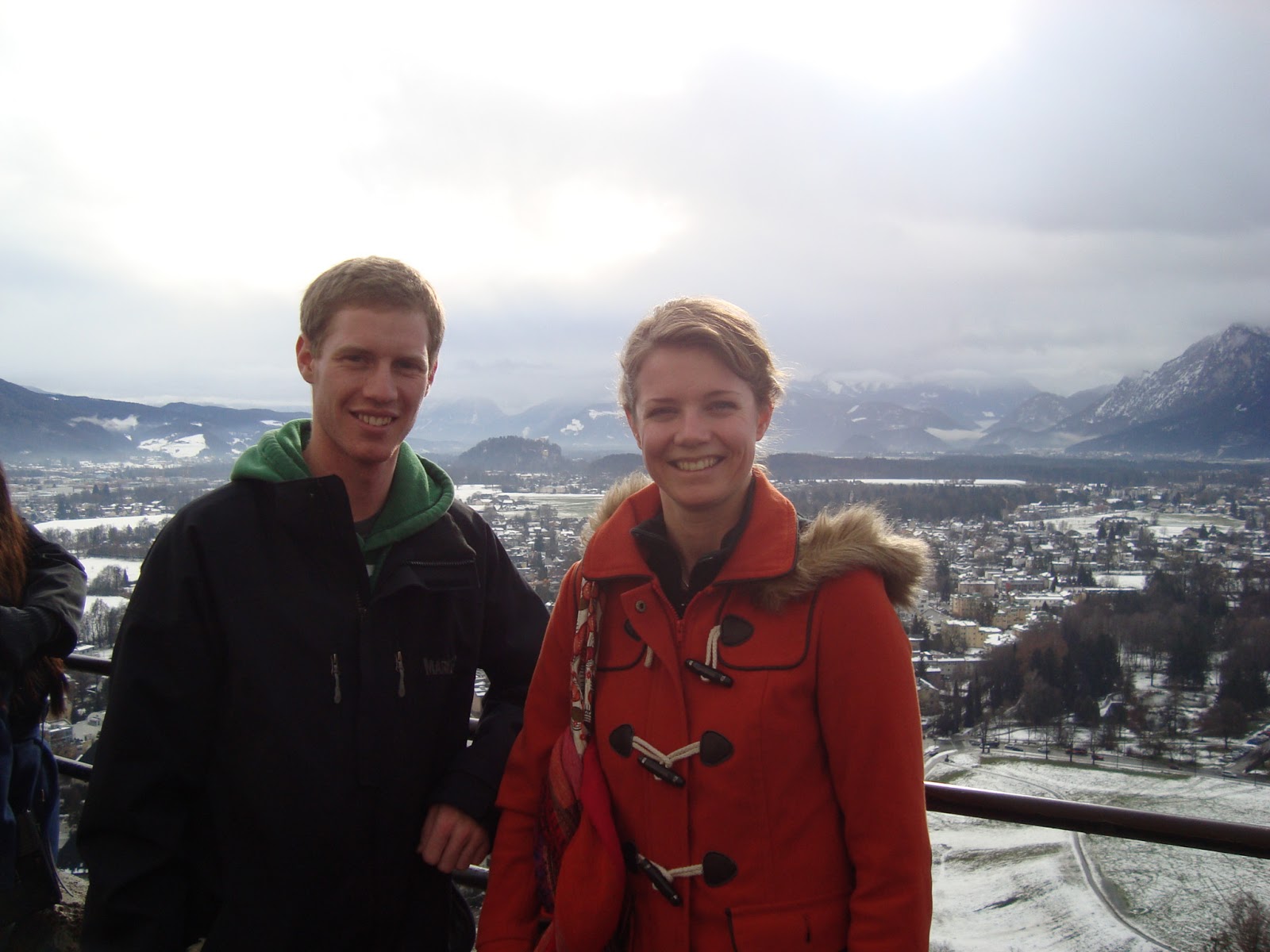
By far the most extravagant part of the Fortress was the view from the very top. It is a hard one to beat.


Our other stops around the city included the Salzburg Dom (Cathedral) and two Mozart museums, one where the great composer was born and one where he lived as a child. The Dom is a stunning piece of Baroque architecture seated in the shadow of the Fortress. In 1944 the dome of the church was destroyed in a bomb attack, and was reconstructed in 1959. It seems that nothing escaped the damaging effects of WWII. This is how the ceiling of the dome looks now.


Garnet and I agree that Mozart's Birthplace was the better of the two Mozart museums. It was exciting to stand in the room where a legend was born, even though the space itself is rather ordinary. There were also impressive Mozart relics such as his childhood violin, locks of hair, wallet, letters, manuscripts and premiere programs for operas such as Die Zauberflöte (The Magic Flute).


A successful tourist is bound to work up an appetite, and Garnet and I were no exception. We managed to locate the Augustiner Brewery on a small back alley (Garnet was navigating this time). Despite its nondescript entrance, which consisted of a small hanging sign and a closed door, the beer hall was massive with grandiose entrance stairs and three large dining rooms. Once again there were satisfying 1L beers, but this time the food was served canteen style, and you rinsed your own stein.


Dessert consisted of pretzels from the Christmas market, and we celebrated being in Salzurg by suitably watching The Sound of Music in the hostel.

 Boy, I could sure go for one of those pretzels about now....

Next stop, Vienna!
Shannon


Wednesday, 16 January 2013

The Day of Polar Opposites: Dachau Concentration Camp & BMW Museum


On our final full day in Munich, Garnet and I ventured outside the city to visit the Dachau Concentration Camp. If you visit Munich, I highly recommend that you set aside at least half a day to visit this memorable landmark. It is very easy to travel to using the metro system and the S Bahn (above ground train), and there is a free bus every ten minutes from the train station to the camp. Entrance to the grounds is free; the only fee being a minimal 2.50 for the audio guide.

The Dachau Concentration Camp was the first concentration camp established by the Nazi party in WWII and acted as a model for other camps that followed. It began housing prisoners in 1933 for political reasons, and at the outset of the war began imprisoning "undesirables" from conquered lands. Nazi propaganda portrayed Dachau as a camp where these prisoners were receiving "re-education." Over 30,000 deaths were recorded by Dachau administration, but this does not include numbers from the death marches held shortly before liberation, prisoners who died after liberation due to their weakened state, or the huge amounts of inmates who died after being transferred to other concentration camps. The true number of deaths caused by Dachau will likely remain unknown forever.

The barracks within the camp were designed for 6,000 inmates, and at the time of liberation by Americans in 1945 there were a reported 32,000 survivors in the camp. Over the course of the war, conditions within the camp progressively decreased until German officers were actually instructed to improve living situations in 1942 to reduce the amount of deaths. However conditions did not improve substantially because in 1945 overcrowding, malnutrition and starvation caused Typhus outbreaks.
 

Structurally, the modern Dachau camp is not the same as in WWII. The entrance gate and fencing remain, as well as the jail bunker, but only two of the original inmate barracks survive. The inscription on the metal entrance gate states ominously that "work sets you free." The large maintenance building has been converted into a museum, which in addition to educational displays houses a theater for the filming of a short documentary. There are several memorials on site, including buildings dedicated to Jewish, Catholic, Protestant and Russian Orthodox faiths.


 This memorial relief depicts figures caught in the fence.

Just outside the fenced grounds are two infamous crematorium buildings; the second built because the first could not handle the increasing number of bodies. The second crematorium includes a gas chamber, but this room was never evidently used for mass murders (though it may have been used for tests). Around the crematoriums lay several grave stones honouring the locations of the deceased.

Our visit to Dachau was an incredibly moving experience, and despite spending five hours there we still could not fathom the atrocities which took place. It had been a warmer day, and the melting snow was soaking and freezing our feet, but we dared not complain given our surroundings. Cold feet do not come close to comparing to the suffering experienced at Dachau. The details I have shared in this blog only scratch the surface of the mass of knowledge we gained from our visit. It is best to experience the camp in person, to see the buildings, walk the grounds and listen to the personal accounts on the audio guide. When I reflect on my trip in years to come, I am confident that my visit to Dachau will remain unforgettable, as it should.

On a happier note, we perfectly paired our Dachau experience with the much more light-hearted BMW museum. The BMW headquarters occupies a large area of land located very near the Munich Olympic grounds. The museum is a completely impressive depiction of innovation, technology and lots and lots of money. The building is very modern with lighted walls and sloping walkways. At the center of the museum, a spirally path large enough for a car winds its way up through the floors. Some of the fascinating technological elements included a room-sized table with touch-screen capabilities outlining the history of BMW, ceiling speakers which read books as you turn the page, and direction-based floor sensors which talk about the display you face. You do not have to have a specific interest in BMW to find this museum amazing. I'll let my pictures do the rest of the explaining.


Next stop will be Salzburg, Austria. Stay Tuned!

Shannon

Saturday, 12 January 2013

Munich, the Heart of Bavaria

After a whirlwind stop in Frankfurt, Garnet and I were ready to spend a little extra time in our next destination, the bustling metropolis of Munich. When we arrived in late afternoon our first priority was to nap... at least for Garnet who was still suffering from jet-lag. By supper-time we were off again to explore.

Armed with our map we headed for Marienplatz, the main square in the city center. Our goal was to eventually arrive at the famous Hofbräuhaus, Munich's largest traditional beer hall. On our way we passed through the Munich Christmas market which was filled with tourists and locals out for a meal and hot drink. We followed the market through the shopping streets until the tall clock tower of Marienplatz greeted us.
The picture above shows the clock tower at the center of Marienplatz. The highlight of this tower is the glockenspiel, or chimed instrument which plays at particular times each day. As it plays, music box figures dance to the music. For a close-up of the figures, check out the picture which I took the following day.


After a few deviations in our evening walk (due to my excellent navigational skills...) we finally arrived at the Hofbräuhaus. It is an incredibly huge building, yet was packed with customers. We walked around for several minutes before asking to share a table with an English couple. Despite its full tables, the service was excellent and we ordered dinner (more meat and potatoes) and beer. The thing about beer-hall beers is that they are huge, 1 Litre to be exact, which basically requires two hands for safe sipping. Both Garnet and I think that Canada should quickly adopt these large steins. They were great!


The next day we got our exercise, trekking around the city to see multiple sights. We began by climbing the tower of St Peter's Church which provided spectacular views of the center of Munich.


The cathedral in the above picture is the Frauenkirche, one of Munich's architectural landmarks dating to the end of the 15th century. It suffered extensive damage during WWII and had to undergo massive restoration lasting into the 1990s. You can see in the photo that one tower was under restoration during our visit, but this was unrelated to damage sustained in the war. The sky-scraping ceilings of the church interior were as impressive as the outside, but its current state is not nearly as ornate as before the War.

The entrance to Frauenkirche is marked by a black footprint in the tile. According to legend, this mark belongs to the Devil who entered the Church and looked up from this spot to see no windows. He laughed in triumph, but as he stepped forward the windows came into view. The Devil realized that he had been defeated and in anger turned into wind, which to this day swirls around the two towers.


Our next stop was the Residenz, Munich's palace. Originally built in 1385, it was inhabited by Bavarian royalty until 1918, and in 1920 became a museum to showcase the impressive staterooms, treasury and theater. Like the Frauenkirche, the Residenz underwent restoration after its roof was almost completely destroyed in WWII.

The Residenz has much to offer, and I have lots of pictures to share. Enjoy!


 Below is the Great Hall, perhaps the greatest room in the Residenz.


 One room in the museum houses the remains of former Bavarian monarchy. We unknowingly wandered in to be greeted by this creepy skull swathed in lace and beads. 
 The treasury included a variety of prized objects, including this bejeweled crown.
With tired feet, Garnet and I made our way out for an evening meal. If you visit Munich, I highly recommend Café Nil on Hans-Sachs-Straße. It is a gay-friendly café with great service and food. I ordered a delicious salad because I was already experiencing vegetable withdrawal from so much meat and potatoes.

For our last day in Munich we planned to visit the Dachau concentration camp and the BMW museum. This day proved to be one of the best in our trip. Make sure you read my next blog to find out more!

Guten Nacht from Ireland!
Shannon